Mob/ Whatsapp/Wechat: +86 138 806 76215 | Email: [email protected] / [email protected]
 Simultaneous detection of Canine Parvovirus / Canine Coronavirus / Canine Distemper Virus / Canine Adenovirus Type II / Mycoplasma
Detection by Real-Time PCR finish detection in 1 hourLyophilized PCR Reagent FormatDirect PCR using lysis solution for rapid template preparation
Research Use Only
Simultaneous detection of Canine Parvovirus / Canine Coronavirus / Canine Distemper Virus / Canine Adenovirus Type II / Mycoplasma
Detection by Real-Time PCR finish detection in 1 hourLyophilized PCR Reagent FormatDirect PCR using lysis solution for rapid template preparation
Research Use Only
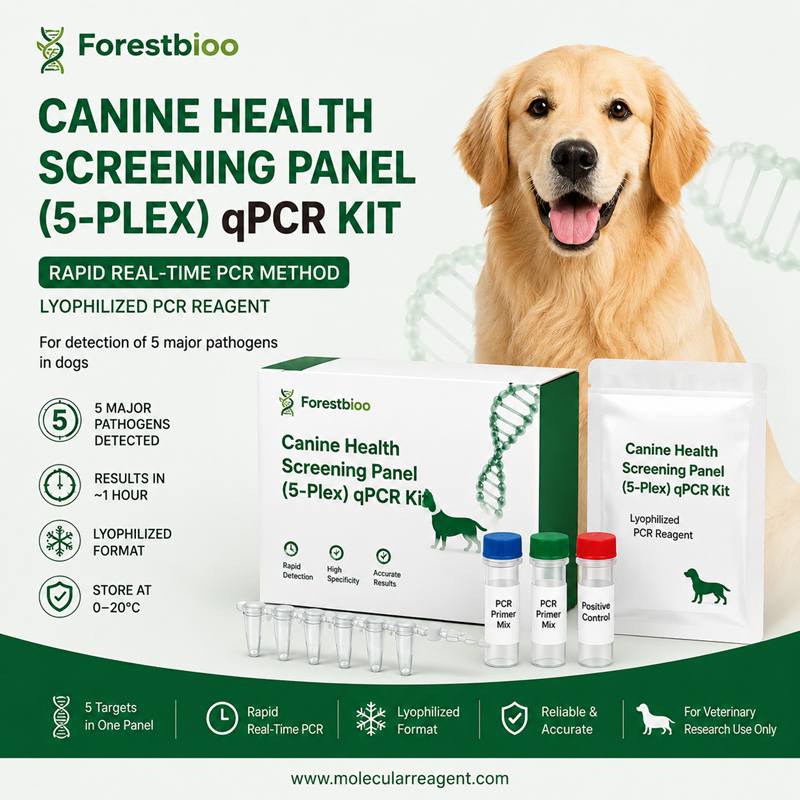
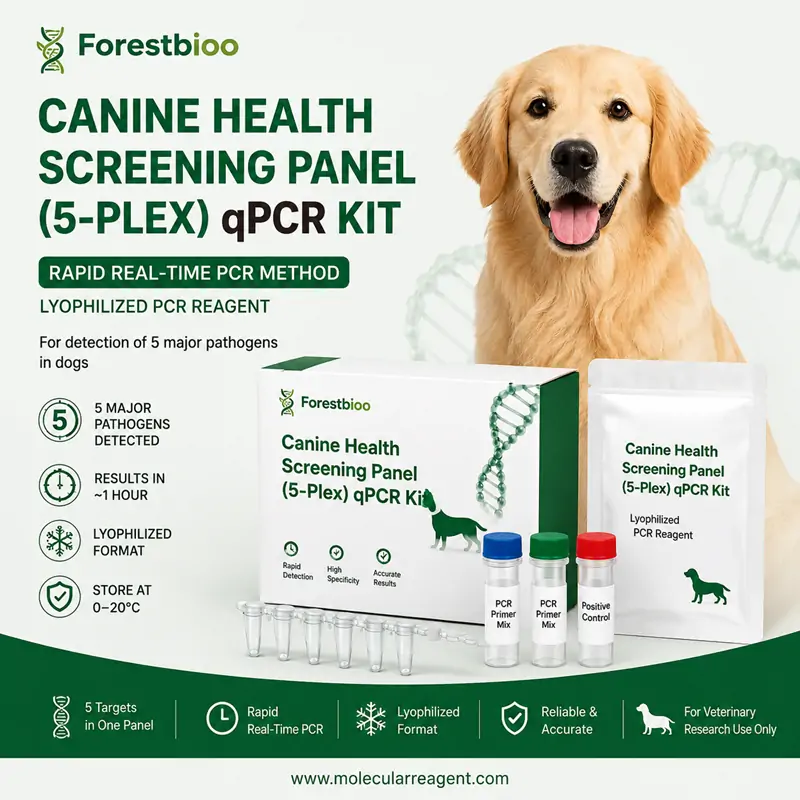
The Canine Health Screening Panel (5-Plex) qPCR Kit(FVPD503) is a multiplex molecular detection kit designed for the detection of five important canine pathogen targets associated with infectious disease research and veterinary health screening.
The panel detects:
Canine Parvovirus (CPV)
Canine Coronavirus (CCoV)
Canine Distemper Virus (CDV)
Canine Adenovirus Type II (CAV-2)
Mycoplasma
The kit uses a rapid real-time fluorescence PCR method and is supplied in a lyophilized PCR reagent format for convenient laboratory testing.
For Veterinary Research Use Only.
The product specification is 10 Tests/Kit, with storage at 0–20°C and a stated shelf life of 12 months.
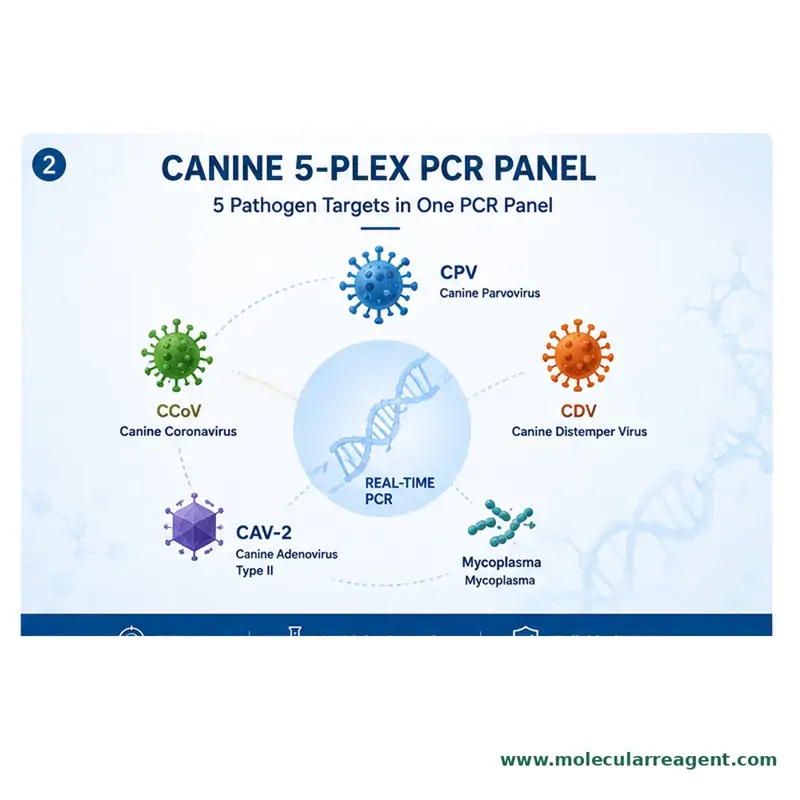
The Canine Health Screening Panel (5-Plex) qPCR Kit combines five canine pathogen targets into one molecular testing panel.
Pathogen | Abbreviation |
Canine Parvovirus | CPV |
Canine Coronavirus | CCoV |
Canine Distemper Virus | CDV |
Canine Adenovirus Type II | CAV-2 |
Mycoplasma | Mycoplasma |
The product instructions specify that the kit is intended for the detection of nucleic acids from these five canine pathogen targets.
Canine Parvovirus is an important pathogen investigated in canine infectious disease research. Molecular detection of CPV nucleic acid can support laboratory research involving canine infectious diseases.
The panel includes a target for Canine Coronavirus, allowing laboratories to include coronavirus testing within a broader canine pathogen screening workflow.
The kit includes Canine Distemper Virus as one of the five molecular detection targets.
The panel includes Canine Adenovirus Type II as specified in the current product instructions.
Mycoplasma is included as the fifth pathogen target in this canine molecular screening panel.
A multi-target PCR panel can provide laboratories with a broader molecular screening approach than a single-pathogen PCR assay.
The Canine Health Screening Panel combines:
CPV + CCoV + CDV + CAV-2 + Mycoplasma
into one five-target testing solution.
5 canine pathogen targets in one PCR panel
Rapid real-time fluorescence PCR
Lyophilized PCR reagent format
Multiple canine swab sample types
Simple sample preparation workflow
Room-temperature storage at 0–20°C
12-month shelf life
10 tests per kit
The current instructions specify the lyophilized format, 10-test package, 0–20°C storage and 12-month shelf life.
The Canine Health Screening Panel is designed for canine swab samples collected according to the product instructions.
Collect an anal swab sample using a new sterile flocked swab.
Collect a canine oral swab sample using a new sterile flocked swab.
Collect a nasal swab sample using a new sterile flocked swab.
Collect a sample from the ocular mucosa using a new sterile flocked swab.
The instructions specifically describe anal swabs and oral, nasal and ocular swab samples as sample types.
The Canine Health Screening Panel uses a simplified sample preparation workflow before real-time fluorescence PCR detection.
Collect the appropriate canine swab sample using a new flocked swab.
Break the swab tip into the Lysis Buffer tube.
Vortex for approximately 30 seconds and briefly centrifuge or flick the tube to bring the liquid to the bottom.
Transfer 20 μL of the processed sample into the Reconstitution Solution tube.
Vortex for approximately 10 seconds and briefly centrifuge.
The processed sample can then be used as the PCR template.
Transfer 20 μL of the prepared sample into one tube of lyophilized PCR reagent.
Cap the tube securely, vortex for approximately 10 seconds, and briefly centrifuge.
Place the prepared reaction tube into the fluorescence PCR instrument and run the designated Canine Health Screening Panel (5-Plex) program.
The current instructions specify adding 20 μL of prepared sample to the lyophilized reagent and using the designated five-target PCR program.
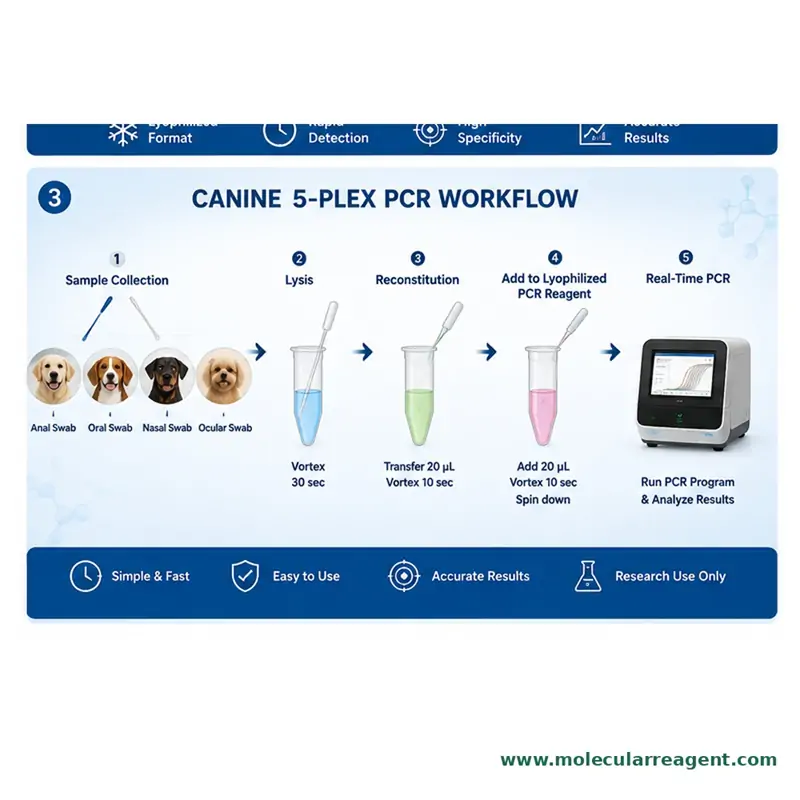
The Canine Health Screening Panel uses rapid real-time fluorescence PCR for molecular detection of the five canine pathogen targets.
The recommended workflow is:
Sample Collection → Lysis → Reconstitution → PCR Reaction → Real-Time Fluorescence Detection
The PCR program specified in the current instructions includes:
Step | Condition | Cycles |
1 | 55°C, 5 min | 1 |
2 | 95°C, 2 min | 1 |
3 | 95°C, 10 sec | 40 |
4 | 58°C, 15 sec, fluorescence acquisition | — |
These conditions are taken directly from the current PD503 instructions.
The kit uses a lyophilized PCR reagent format, providing a convenient format for laboratory molecular testing.
Pre-formulated PCR reagent
Convenient laboratory handling
Reduced reagent preparation
Room-temperature storage
Suitable for veterinary research workflows
The kit contains 10 Lysis Buffer tubes, 10 Reconstitution Solution tubes, 10 lyophilized reagent units and one bag of 8-tube strip caps.
Specification | Details |
Product Name | Canine Health Screening Panel (5-Plex) qPCR Kit |
Method | Rapid Real-Time Fluorescence PCR |
Format | Lyophilized PCR Reagent |
Detection Targets | 5 Canine Pathogens |
Target 1 | Canine Parvovirus (CPV) |
Target 2 | Canine Coronavirus (CCoV) |
Target 3 | Canine Distemper Virus (CDV) |
Target 4 | Canine Adenovirus Type II (CAV-2) |
Target 5 | Mycoplasma |
Sample Type | Anal / Oral / Nasal / Ocular Swab |
Package Size | 10 Tests/Kit |
Storage | 0–20°C |
Shelf Life | 12 Months |
Intended Use | Veterinary Research Use Only |
All of the above core specifications are based on the latest uploaded PD503 instruction sheet.
The product instructions specify the following equipment and laboratory consumables:
T-8 Fluorescence PCR Pet Detection System
Vortex Mixer
Mini Centrifuge
Micropipette
Pipette Tips
After PCR amplification, the fluorescence curve and threshold should be evaluated according to the product instructions.
The current PD503 instructions specify:
Ct ≤ 36.0 — Positive
Ct > 36.0 — Negative
The threshold should be adjusted based on the normal negative control and the best linearity of the amplification curves. A positive fluorescence curve should show a clear S-shaped amplification curve above the threshold.
Important: Result interpretation should follow the complete product instructions and appropriate laboratory quality-control procedures.
The Canine Health Screening Panel (5-Plex) qPCR Kit can support veterinary molecular research involving:
Molecular research involving multiple canine pathogen targets.
Screening research involving canine infectious disease-associated pathogens.
Research laboratories evaluating multi-target real-time PCR workflows.
Molecular research involving canine gastrointestinal, respiratory and systemic infectious disease-associated pathogens.
The kit detects five canine pathogen targets:
Canine Parvovirus, Canine Coronavirus, Canine Distemper Virus, Canine Adenovirus Type II and Mycoplasma.
The product is a 5-Plex canine pathogen PCR panel containing five detection targets.
The product instructions specify anal swabs and oral, nasal or ocular swab samples.
Is the PCR reagent lyophilized?
Yes. The kit uses a lyophilized PCR reagent format.
The package specification is 10 Tests/Kit.
The recommended storage temperature is 0–20°C.
The stated shelf life is 12 months.
The instructions specify the T-8 Fluorescence PCR Pet Detection System.
According to the current product instructions, a sample with Ct ≤ 36.0 is interpreted as positive, while Ct > 36.0 is interpreted as negative.
No. The product is intended for veterinary research use only. It should not be presented as a product for human use, animal treatment or clinical diagnosis.
For laboratories looking for a Canine 5-Plex qPCR Kit, this product provides a convenient molecular testing solution covering five canine pathogen targets in one panel.
Canine Parvovirus
Canine Coronavirus
Canine Distemper Virus
Canine Adenovirus Type II
Mycoplasma
Combined with a rapid real-time fluorescence PCR method and lyophilized reagent format, the panel is designed for convenient use in veterinary molecular research laboratories.
Canine Distemper Virus (CDV) qPCR Detection Kit(FVPD102)
Canine Parvovirus & Coronavirus Duplex qPCR Kit(FVPD201)
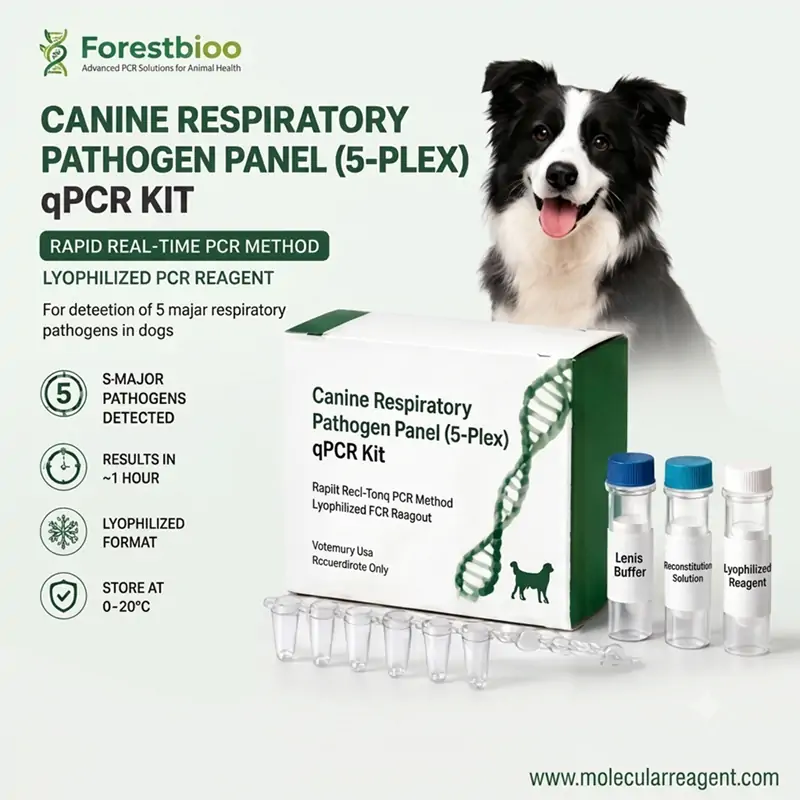
Canine Respiratory Pathogen Panel (5-Plex) qPCR Kit(FVPD501)
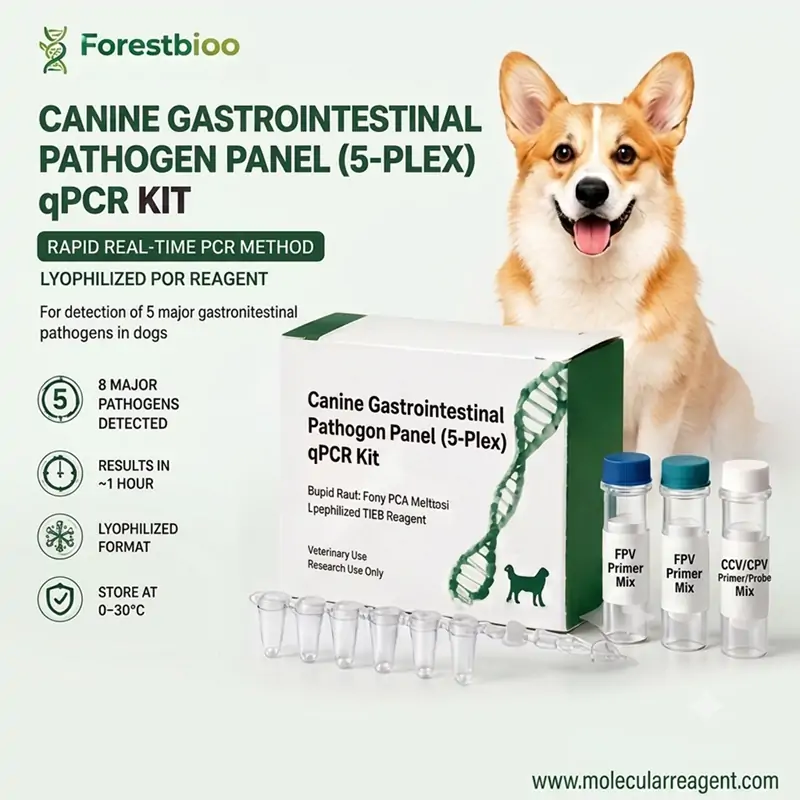
Canine Gastrointestinal Pathogen Panel (5-Plex) qPCR Kit(FVPD502)
Canine Health Screening Panel (5-Plex) qPCR Kit(FVPD503)
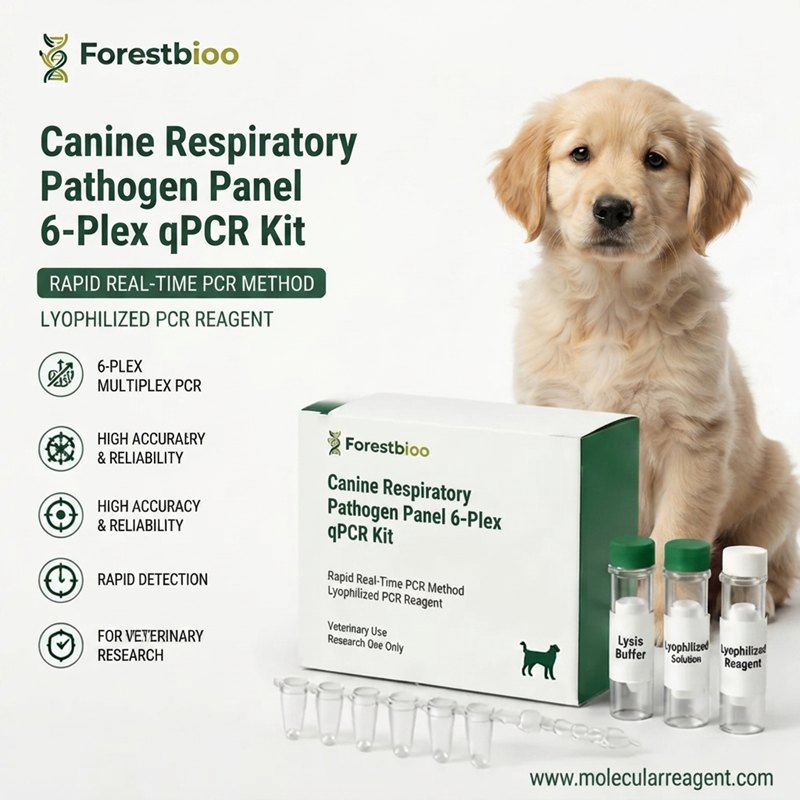
Canine Respiratory Pathogen Panel (6-Plex) qPCR Kit (FVPD601)
Looking for a Canine 5-Plex qPCR Kit for your veterinary laboratory?
Contact us for:
Product specifications
Technical documentation
Evaluation samples
Bulk pricing
Distributor pricing
OEM / private-label opportunities
Request a Quote
Contact us to discuss your canine molecular testing requirements.