
Feline Infectious Peritonitis (FIP) Diagnosis: PCR Testing, Samples & Interpretation
August 18, 2026
Feline infectious peritonitis (FIP) is a complex and potentially fatal disease associated with feline coronavirus (FCoV) infection. Because FIP can present with a wide range of clinical signs and laboratory findings, no single non-invasive test can reliably establish FIP in every cat.
Molecular testing, including real-time reverse transcription PCR (RT-qPCR), can provide valuable evidence of feline coronavirus RNA in appropriate clinical samples. However, PCR results should always be interpreted together with the cat's clinical history, physical examination, laboratory findings, imaging, and other diagnostic evidence.
This guide explains how FIP is evaluated, when PCR testing may be useful, which samples can be considered, and how veterinary laboratories can interpret molecular test results.
What Is Feline Infectious Peritonitis (FIP)?
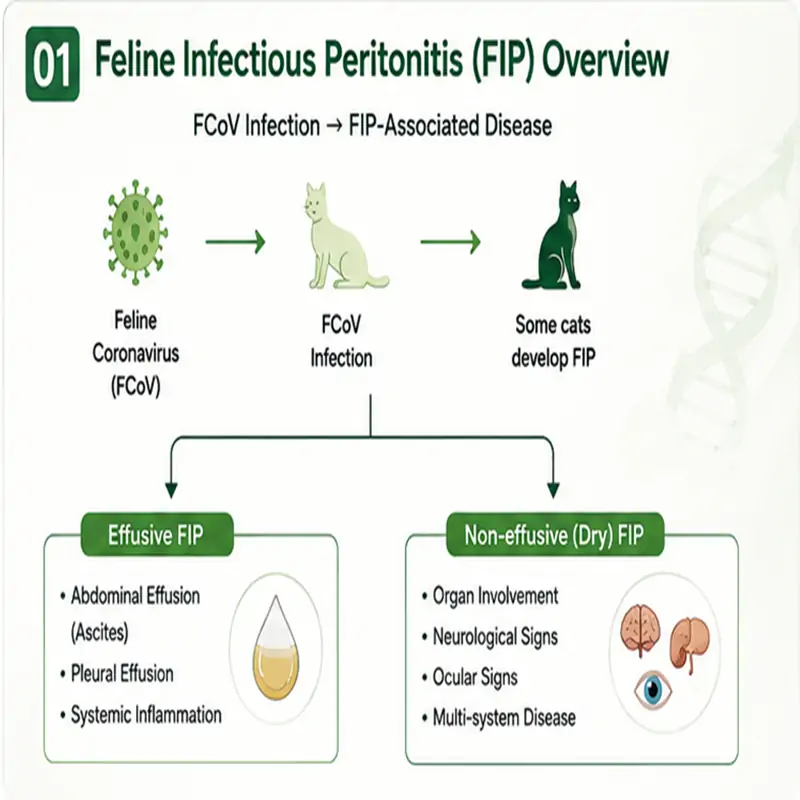
Feline infectious peritonitis is a systemic disease associated with feline coronavirus infection. Feline coronavirus is common among cats, particularly in multi-cat environments such as catteries, shelters, rescue facilities, and other high-density populations.
Most FCoV infections do not result in FIP. This is one of the main reasons why FIP diagnosis can be challenging.
FIP may be associated with systemic inflammation and can affect multiple organs. Clinical presentations may include:
Fever
Loss of appetite
Weight loss or poor growth
Lethargy
Abdominal or thoracic effusion
Neurological abnormalities
Ocular abnormalities
Enlarged lymph nodes
Changes in blood or serum biochemical parameters
The clinical presentation varies considerably between individual cats. The 2022 AAFP/EveryCat FIP Diagnosis Guidelines emphasize that veterinarians should build the diagnostic picture by integrating history, signalment, clinical examination, laboratory findings, imaging, and appropriate sample testing.
Why Is FIP Difficult to Diagnose?
One of the biggest challenges in FIP testing is that feline coronavirus infection is not equivalent to FIP.
FCoV is widespread in cats, and viral RNA can sometimes be detected in cats that do not have FIP. Therefore, detection of FCoV RNA by PCR does not automatically establish a diagnosis of FIP.
The diagnostic value of a test depends on several factors, including:
The cat's clinical presentation
The presence or absence of effusion
The type of sample tested
The amount of viral RNA detected
The analytical characteristics of the PCR assay
Other laboratory findings
Imaging findings
The overall probability of FIP before testing
The AAFP/EveryCat guidelines specifically note that real-time RT-PCR can detect FCoV RNA in blood, effusion, cerebrospinal fluid, aqueous humor, tissue, and fine-needle aspirates, but detection of FCoV RNA alone is not necessarily specific for FIP.
How Is PCR Used in FIP Testing?
What Does FIP PCR Detect?
Real-time reverse transcription PCR (RT-qPCR) is a molecular method used to detect RNA sequences associated with feline coronavirus.
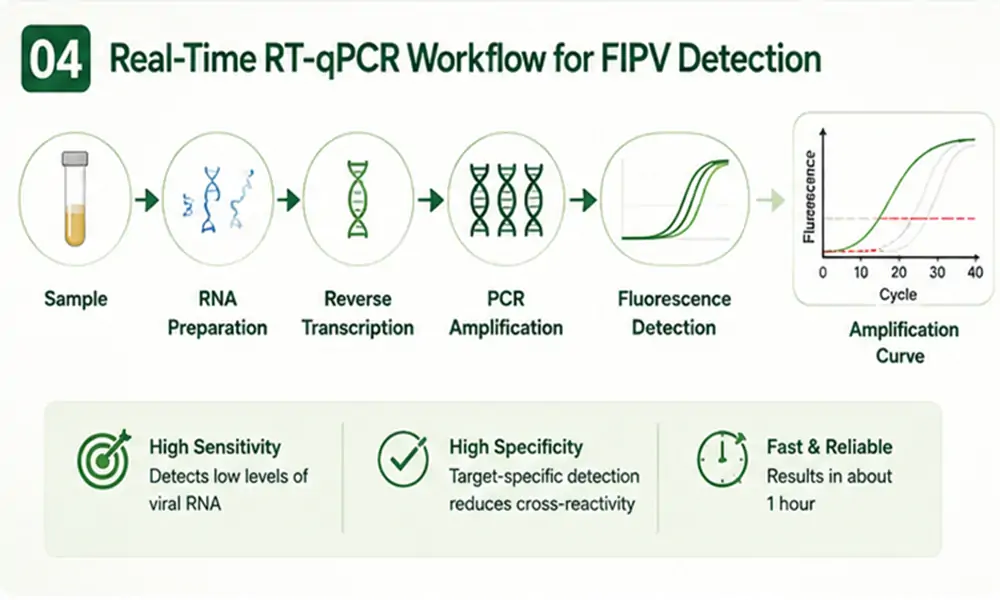
In a PCR workflow, viral RNA is first converted into complementary DNA, followed by amplification of a specific target sequence. Fluorescence generated during amplification allows the target to be detected in real time.
For veterinary research laboratories, RT-qPCR can therefore provide molecular evidence that complements other diagnostic information.
Why Use Real-Time PCR?
Real-time PCR offers several practical advantages for molecular testing:
Rapid detection
High analytical sensitivity
Target-specific amplification
Real-time fluorescence monitoring
Compatibility with established fluorescence PCR platforms
However, analytical performance depends on the assay design, target sequence, sample quality, extraction or preparation method, and instrument configuration.
Which Samples Can Be Used for FIP PCR Testing?
Sample selection is an important part of FIP molecular testing.
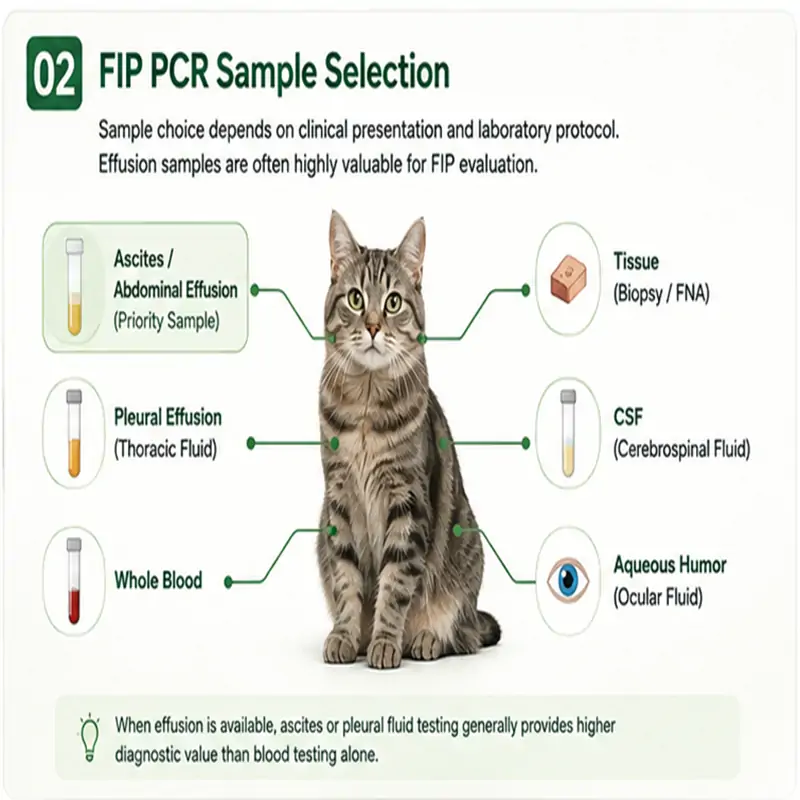
Depending on the clinical presentation and laboratory protocol, potential samples may include:
Abdominal effusion / ascites
Pleural effusion
Whole blood
Serum or plasma
Tissue
Fine-needle aspirates
Cerebrospinal fluid
Aqueous humor
The AAFP/EveryCat guidelines indicate that diagnostic testing can be performed on a variety of sample types, while the diagnostic value varies according to the clinical situation.
Why Is Ascites Important for FIP Testing?
When abdominal effusion is present, ascites can be an especially useful sample for FIP evaluation.
The AAFP/EveryCat guidelines report that tests performed on effusion generally have higher positive predictive values than tests performed on blood. ABCD guidance also emphasizes prioritizing effusion sampling when effusion is available.
Cornell University's Animal Health Diagnostic Center lists peritoneal or pleural fluid as preferred antemortem samples for FIP-suspect coronavirus PCR testing, followed by other sample types depending on the clinical situation.
This makes ascites an important sample type to consider when evaluating cats with suspected effusive FIP.
FIP PCR Testing Using Feline Ascites
For cats presenting with abdominal effusion, ascites may provide a practical sample for molecular testing.
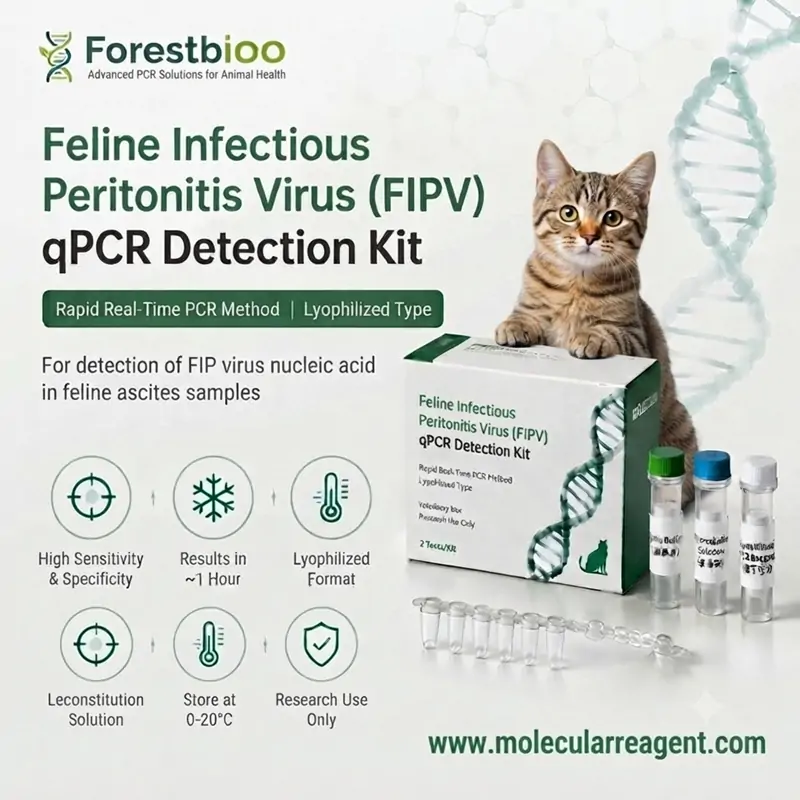
Your Feline Infectious Peritonitis Virus (FIPV) qPCR Detection Kit is designed for the detection of FIP virus nucleic acid in feline ascites samples. The product uses a Rapid Real-Time PCR Method and a lyophilized format, according to the product information provided for PC101.
FIPV qPCR Detection Kit
Method: Rapid Real-Time PCR Method
Format: Lyophilized
Sample Type: Feline ascites
Storage: 0–20°C
Intended Use: Veterinary Research Use Only
The kit is designed to support molecular research involving FIP-associated feline coronavirus nucleic acid.
Important: A PCR result should not be interpreted as a standalone clinical diagnosis of FIP. Molecular findings should be evaluated together with the clinical presentation and other diagnostic evidence.
[View FIPV qPCR Detection Kit →]
How Should FIP PCR Results Be Interpreted?
What Does a Positive FIP PCR Result Mean?
A positive PCR result indicates that the target viral nucleic acid was detected in the tested sample according to the characteristics of the assay.
However, a positive FCoV PCR result does not automatically confirm FIP.
This distinction is important because feline coronavirus can be detected in cats that do not have FIP.
The diagnostic meaning of a positive result depends on:
Sample type
Clinical signs
Viral RNA quantity
Other laboratory findings
Imaging results
Disease probability
PCR assay characteristics
The AAFP/EveryCat guidelines note that cats with FIP generally have higher FCoV viral loads and that a positive RT-qPCR result with a high viral load, when accompanied by consistent clinical signs and clinicopathological findings, can be strongly suggestive of FIP.
What Does a Negative PCR Result Mean?
A negative result means that the target was not detected above the assay's detection criteria in the tested sample.
However, a negative result does not necessarily exclude FIP in every clinical situation.
Potential factors include:
Sample type
Viral load
Disease stage
Sample quality
Target distribution
Assay performance
Therefore, sample selection and clinical context remain important when interpreting PCR results.
Does a Positive FCoV PCR Result Confirm FIP?
No.
A positive feline coronavirus PCR result should not be interpreted as definitive proof of FIP.
FCoV infection is common in cats, and non-FIP cats can also carry or shed feline coronavirus.
The AAFP/EveryCat guidelines state that detection of FCoV RNA by RT-qPCR in blood, fluid, tissue, or other samples is not necessarily specific for FIP. Cornell University likewise notes that there is currently no single definitive test that establishes FIP in every case.
Therefore:
PCR is one component of the FIP diagnostic picture—not a standalone diagnosis.
This is especially important when developing testing strategies for veterinary laboratories.
FIP Diagnosis: PCR vs Other Diagnostic Methods
FIP evaluation often involves multiple diagnostic approaches.
Diagnostic Method | What It Can Provide |
CBC | General hematological information |
Serum Biochemistry | Information about systemic and organ-related changes |
A:G Ratio | Additional evidence when interpreted in context |
Rivalta's Test | Supports evaluation of effusion |
Cytology | Cellular characteristics of effusion |
Bacterial Culture | Helps investigate bacterial causes of effusion |
Imaging | Helps identify effusion and organ abnormalities |
RT-qPCR | Detects feline coronavirus RNA in appropriate samples |
Histopathology / Immunohistochemistry | Can provide stronger confirmatory evidence in selected cases |
No single method should be considered sufficient in every FIP case.
The AAFP/EveryCat guidelines emphasize integrating multiple pieces of evidence and selecting diagnostic tests according to the individual cat's presentation.
FIP Diagnostic Workflow
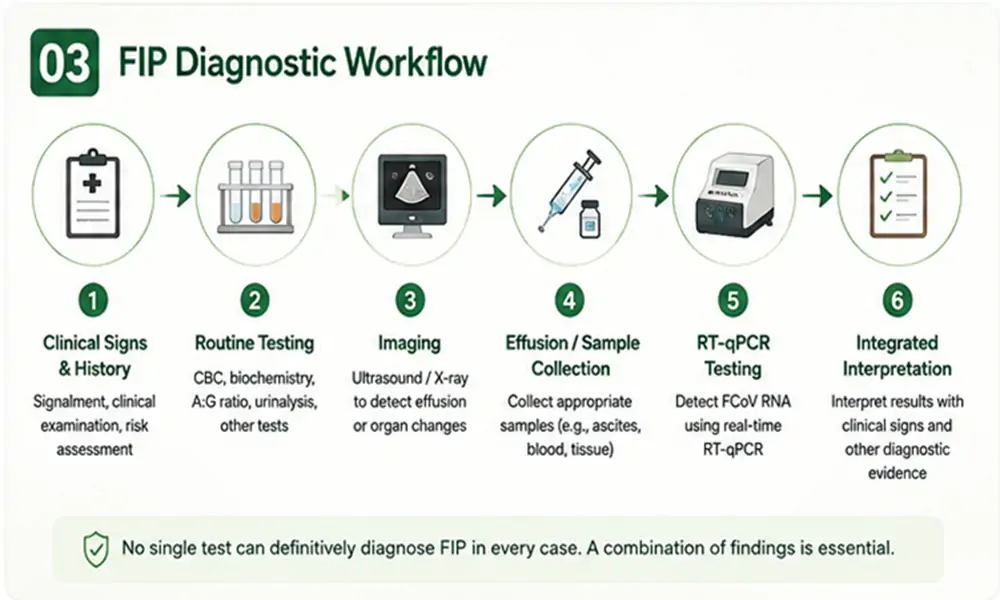
A practical molecular testing workflow can be considered as part of a broader FIP evaluation:
Suspected FIP
↓
Clinical History & Physical Examination
↓
CBC / Serum Biochemistry / Other Routine Tests
↓
Imaging and Assessment for Effusion
↓
Sample Selection
↓
Effusion / Ascites Analysis
↓
Molecular Testing such as RT-qPCR
↓
Interpret PCR Results Together With Clinical Evidence
↓
Overall Diagnostic Assessment
This approach helps prevent overinterpretation of a single molecular test.
Why Sample Selection Matters in FIP PCR Testing
The choice of sample can significantly affect the diagnostic value of molecular testing.
When effusion is available, testing the fluid may provide more useful information than relying solely on blood.
For suspected effusive FIP, abdominal or thoracic fluid can therefore be particularly valuable.
The AAFP/EveryCat guidelines recommend considering effusion whenever available because diagnostic accuracy is generally higher with effusion-based testing than with blood-based testing.
Cornell's coronavirus PCR guidance similarly places peritoneal and pleural fluid among the preferred antemortem samples for FIP-suspect testing.
Real-Time PCR for Veterinary FIP Research
Real-time PCR can be useful for veterinary laboratories conducting research on feline coronavirus and FIP-associated molecular testing.
A suitable workflow should consider:
Sample Quality
Proper sample collection and handling are essential for obtaining reliable molecular results.
Assay Target
Different PCR assays may target different regions of the viral genome. Therefore, laboratories should understand the target sequence and analytical characteristics of the assay they use.
Instrument Compatibility
Real-time fluorescence PCR requires an instrument compatible with the assay's fluorescence detection system.
Result Interpretation
PCR results should be evaluated in combination with clinical and laboratory information rather than interpreted in isolation.
FIP PCR Testing for Veterinary Laboratories
Veterinary diagnostic laboratories, animal health research laboratories, veterinary hospitals, and academic research groups may require molecular assays for feline coronavirus research.
When evaluating a veterinary PCR kit, laboratories may consider:
Target sequence
Sample compatibility
Analytical sensitivity
Specificity
PCR chemistry
Fluorescence channels
Reaction format
Reagent stability
Storage requirements
Workflow time
Instrument compatibility
For laboratories looking for a ready-to-use molecular testing format, lyophilized PCR reagents can also simplify storage and transportation compared with conventional liquid reagents.
FIPV qPCR Detection Kit for Feline Ascites Samples
The Feline Infectious Peritonitis Virus (FIPV) qPCR Detection Kit is designed for molecular detection of FIP-associated feline coronavirus nucleic acid in feline ascites samples.
Product Highlights
Rapid Real-Time PCR Method
Lyophilized PCR Format
Feline Ascites Sample
Fast Molecular Detection Workflow
Storage at 0–20°C
Veterinary Research Use Only
The product information supplied for PC101 specifies feline ascites as the sample type and describes a lyophilized real-time PCR format.
Looking for a FIPV qPCR Assay?
If you are a veterinary laboratory, animal health researcher, diagnostic laboratory, or distributorlooking for an FIPV molecular detection solution, contact us for product information, evaluation options, and cooperation opportunities.
[Explore the FIPV qPCR Detection Kit →]
[Contact Us for a Quote →]

Frequently Asked Questions About FIP PCR Testing
Can PCR diagnose FIP in cats?
PCR can provide important molecular evidence by detecting feline coronavirus RNA in an appropriate sample, but PCR alone should not be considered a definitive diagnosis of FIP. Results should be interpreted together with clinical signs and other diagnostic findings.
Is ascites a good sample for FIP PCR testing?
When abdominal effusion is present, ascites can be a valuable sample for FIP molecular testing. Effusion-based testing generally has greater diagnostic value than testing blood alone in cats with suspected FIP.
Can feline coronavirus PCR be positive without FIP?
Yes. Feline coronavirus is common in cats, and FCoV RNA may be detected in cats that do not have FIP. Therefore, a positive PCR result requires clinical context.
What samples can be used for FIP PCR?
Depending on the clinical presentation and assay, possible samples include abdominal or pleural effusion, blood, tissue, CSF, aqueous humor, and fine-needle aspirates. Sample selection should be based on the clinical situation and the laboratory's validated testing protocol.
Is real-time PCR useful for veterinary FIP research?
Yes. Real-time RT-PCR can be used to detect feline coronavirus RNA and provide molecular evidence as part of a broader veterinary research or diagnostic evaluation workflow.
Does a negative FIP PCR result rule out FIP?
Not necessarily. The interpretation of a negative result depends on the sample type, viral load, disease stage, assay characteristics, and clinical context. A negative molecular result should therefore be interpreted together with other available evidence.
Key Takeaways
FIP diagnosis is a multi-factor evaluation rather than a single-test diagnosis.
The most important points are:
Feline coronavirus infection does not automatically mean FIP.
PCR can provide valuable molecular evidence but should not be interpreted alone.
Sample selection is critical for FIP molecular testing.
When effusion is available, ascites or other effusion samples can be particularly valuable.
Real-time RT-PCR can support veterinary molecular research and FIP testing workflows.
PCR results should always be interpreted together with clinical findings and other diagnostic evidence.
Research Use Disclaimer
The information in this article is provided for veterinary research and educational purposes. PCR results should be interpreted by qualified professionals together with appropriate clinical and laboratory information. The FIPV qPCR Detection Kit is for Research Use Only (RUO) and is not intended to diagnose, treat, cure, or prevent disease.