
Feline Respiratory PCR Testing: 6-Plex qPCR Panel for Cats | Forest BioTech
September 20, 2026
Respiratory disease is a common molecular testing application in cats, and several different pathogens may be associated with respiratory signs. When a laboratory needs to investigate multiple targets, multiplex real-time PCR can provide a practical molecular testing workflow by detecting several targets within a single reaction.
The Forest BioTech FVPC602 Feline Respiratory Pathogen Panel (6-Plex) qPCR Kit is designed for molecular research involving six feline respiratory pathogen targets, with target markers including thymidine kinase, ORF1 nonstructural protein, 16S rRNA, flagellin (flaA), and matrix protein 1 (M1). The assay uses real-time fluorescence PCR technology and a lyophilized reagent format, with oral, nasal, and ocular swabs as the sample types specified in the product protocol.
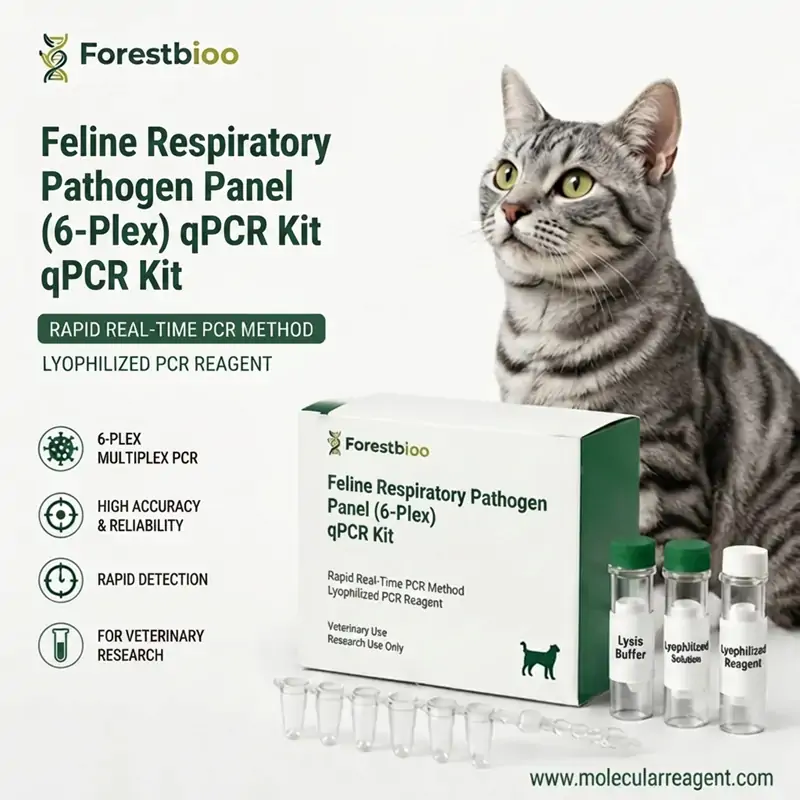
This article explains the principles, targets, sample preparation, PCR workflow, result interpretation, and laboratory considerations associated with feline respiratory PCR testing.
What Is Feline Respiratory PCR Testing?
Feline respiratory PCR testing uses polymerase chain reaction technology to detect nucleic acid targets associated with respiratory pathogens.
Compared with approaches that focus on a single pathogen, a multiplex PCR panel can include several targets in one testing workflow.
For veterinary molecular laboratories, this can be useful when respiratory samples may need to be evaluated against multiple pathogen targets.
A typical feline respiratory PCR workflow includes:
Sample Collection → Sample Preparation → Real-Time PCR → Fluorescence Detection → Result Interpretation
The FVPC602 panel applies this approach to six specified respiratory targets.
Why Use a Multiplex Feline Respiratory PCR Panel?
Respiratory testing may involve more than one potential pathogen target. A laboratory therefore may need a workflow that can evaluate multiple targets without running a separate reaction for every target.
A multiplex PCR panel brings several targets together within one testing format.
Potential workflow advantages include:
Multiple targets evaluated within one multiplex panel
Real-time fluorescence detection
Simplified sample preparation
Lyophilized PCR reagent format
Compatibility with the specified T-8 fluorescence PCR pet detection system
Ct-based result interpretation
A standardized workflow for molecular research
The exact performance and suitability of any PCR assay should be evaluated according to the laboratory's intended application and validation requirements.
What Does the FVPC602 Feline Respiratory PCR Panel Detect?
The FVPC602 Feline Respiratory Pathogen Panel (6-Plex) qPCR Kit contains six molecular targets specified in the product protocol:
Target | Testing Category |
Feline Herpesvirus | Feline respiratory pathogen target |
Feline Calicivirus | Feline respiratory pathogen target |
Feline Mycoplasma | Feline respiratory bacterial target |
Feline Chlamydia | Feline respiratory bacterial target |
Bordetella bronchiseptica | Feline respiratory bacterial target |
Feline Influenza | Feline respiratory pathogen target |
This combination allows laboratories to evaluate multiple respiratory pathogen targets from feline respiratory samples using a multiplex real-time PCR workflow.
Feline Respiratory PCR Sample Types
According to the FVPC602 product protocol, the recommended sample types are:
Oral swabs
Nasal mucosa swabs
Ocular swabs
A new flocked swab is specified for sample collection.
The sample should be handled according to the laboratory's established sample collection and biosafety procedures.
Because sample quality can affect molecular testing, appropriate collection and handling are important parts of the overall PCR workflow.
FVPC602 Feline Respiratory 6-Plex qPCR Workflow
One of the key features of the FVPC602 workflow is that the respiratory swab sample does not require a conventional multi-step nucleic acid extraction procedure described in the protocol.
The workflow uses a lysis solution followed by direct transfer of the processed sample into the PCR preparation system.
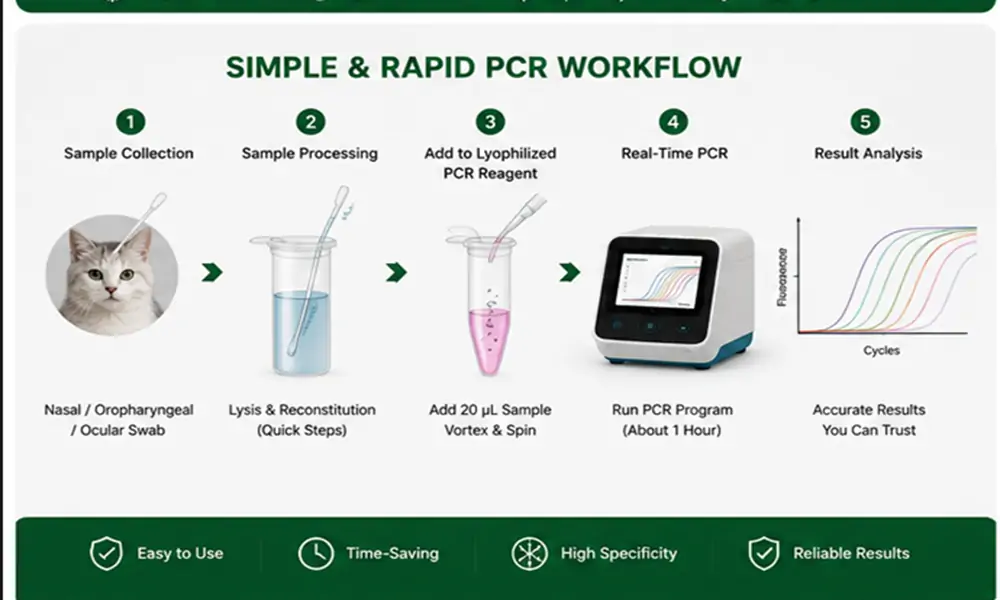
Step 1 — Sample Lysis
Break the swab head into the lysis solution.
Vortex for approximately 30 seconds.
Step 2 — Transfer Processed Sample
Transfer 20 μL of the processed sample into the reconstitution solution.
Vortex for approximately 10 seconds.
Step 3 — Add Sample to Lyophilized PCR Reagent
Transfer 20 μL of the prepared sample into the lyophilized PCR reagent.
Cap the reaction tube, vortex briefly, and perform a brief centrifugation according to the product protocol.
Step 4 — Real-Time Fluorescence PCR
Place the prepared tubes into the PCR instrument and run the designated Feline Respiratory Six program.
The product protocol specifies fluorescence acquisition during the 58°C step.
The complete sample preparation and PCR workflow is described in the FVPC602 product instructions.
FVPC602 PCR Program
The product protocol specifies the following PCR program:
Step | Temperature | Time | Cycles |
Reverse transcription / initial reaction step | 55°C | 5 min | 1 |
Initial denaturation | 95°C | 2 min | 1 |
Denaturation | 95°C | 10 sec | 40 |
Annealing / fluorescence acquisition | 58°C | 15 sec | 40 |
Fluorescence is acquired during the 58°C step.
The PCR program and fluorescence acquisition conditions are based on the FVPC602 product protocol.
Note: The 55°C step is reproduced from the product protocol. Laboratories should follow the current product instructions supplied with the kit.
How Are Feline Respiratory PCR Results Interpreted?
Real-time PCR results are evaluated using amplification curves and Ct values.
According to the FVPC602 protocol, the threshold should be positioned above the highest normal negative control, with a clear S-shaped amplification curve used as part of result evaluation.
The specified interpretation is:
Ct ≤ 36: Positive
Ct > 36: Negative
Result interpretation should always be performed together with the appropriate controls and according to the current product instructions.
Why Lyophilized Reagents Can Be Useful for Veterinary PCR Workflows
The FVPC602 kit uses lyophilized PCR reagents.
Lyophilized reagents can be useful for laboratories and distributors because the PCR reaction components are supplied in a prepared dry format.
For veterinary molecular testing applications, this format can support:
Simplified reagent preparation
Standardized reaction setup
Convenient kit handling
Easier transportation and storage management
Reduced need for users to prepare individual PCR components
The FVPC602 protocol specifies storage at 0–20°C and a 12-month shelf life under the stated storage conditions.
FVPC602 Product Specifications
Item | FVPC602 Specification |
Product | Feline Respiratory Pathogen Panel (6-Plex) qPCR Kit |
Method | Real-Time Fluorescence PCR |
Format | Lyophilized |
Targets | 6 feline respiratory pathogen targets |
Sample | Oral, nasal mucosa, ocular swabs |
Package | 10 tests/kit |
Storage | 0–20°C |
Shelf Life | 12 months |
Instrument | T-8 Fluorescence PCR Pet Detection System |
Intended Application | Veterinary research |
The product packaging and specifications are based on the supplied FVPC602 product instructions.
What Equipment Is Needed for Feline Respiratory PCR Testing?
The FVPC602 workflow uses several basic laboratory tools together with the fluorescence PCR instrument.
The product protocol specifies:
T-8 fluorescence PCR pet detection system
Vortex mixer
Mini centrifuge
Pipette
Pipette tips
The T-8 system can be used as the fluorescence PCR platform for the specified feline respiratory program.
For laboratories building a more integrated veterinary molecular testing workflow, Forest BioTech can also discuss PCR instrument and software configurations according to the laboratory's requirements.
Multiplex PCR vs. Single-Target Feline Respiratory PCR
Both multiplex and single-target PCR assays can have roles in veterinary molecular testing.
Testing Approach | General Workflow Concept |
Single-target PCR | One target is evaluated per assay |
Multiplex PCR | Multiple targets are evaluated within one multiplex reaction |
A multiplex panel may be useful when a laboratory wants to investigate several predefined pathogen targets within one testing workflow.
A single-target assay may be more appropriate when the laboratory has a specific pathogen target or testing requirement.
The choice depends on the laboratory's testing purpose, target requirements, workflow, validation strategy, and available equipment.
How to Choose a Feline Respiratory PCR Kit
When evaluating a feline respiratory PCR panel, laboratories and distributors may want to consider several factors.
1. Target Coverage
Check whether the panel contains the pathogen targets relevant to your testing application.
For FVPC602, the panel includes six specified targets.
2. Sample Type
Confirm that the assay supports the sample types routinely collected by your laboratory.
FVPC602 is designed for oral, nasal mucosa, and ocular swabs according to the product protocol.
3. PCR Platform
Confirm compatibility with the available real-time fluorescence PCR system.
For laboratories using their own instrument, compatibility should be evaluated based on the instrument configuration and assay requirements.
4. Reagent Format
Lyophilized reagents may offer practical advantages for laboratories looking for simplified preparation and storage.
5. Workflow
Consider the number of sample preparation steps, hands-on time, and whether the workflow fits the laboratory's existing PCR process.
6. Intended Use
Confirm that the product's intended-use statement matches your application.
FVPC602 for Veterinary Molecular Research
The FVPC602 panel can be considered for veterinary molecular research workflows involving feline respiratory pathogen targets.
Potential users include:
Veterinary research laboratories
Veterinary molecular testing laboratories
Animal hospitals with molecular research capabilities
Veterinary diagnostic research organizations
Feline breeding and health research organizations
Veterinary laboratory distributors
PCR testing service providers
The appropriate use of the assay depends on local regulations, laboratory validation, and the intended application.
Related Feline Veterinary PCR Kits
FVPC602 is part of the broader Forest BioTech Feline PCR Kit portfolio.
Feline Infectious Disease PCR
Feline Infectious Peritonitis Virus (FIPV) qPCR Detection Kit — FVPC101
View Feline FIPV qPCR Detection Kit
Feline Panleukopenia Virus (FPV) qPCR Detection Kit — FVPC104
View Feline FPV qPCR Detection Kit
Feline Panleukopenia & Coronavirus Duplex qPCR Kit — FVPC201
View Feline Panleukopenia & Coronavirus PCR Kit
Feline Respiratory PCR
Feline Respiratory 5-Plex qPCR Detection Kit — FVPC502
View Feline Respiratory 5-Plex qPCR Kit
Feline Herpesvirus-1 / Feline Calicivirus Duplex qPCR Kit — FVPC203
View Feline FHV-1 / FCV qPCR Kit
Feline Respiratory Pathogen Panel (6-Plex) qPCR Kit — FVPC602
View FVPC602 Feline Respiratory 6-Plex qPCR Panel
Feline Gastrointestinal & Diarrhea PCR
Feline Gastrointestinal 5-Plex qPCR Kit — FVPC501
View Feline Gastrointestinal PCR Kit
Feline Diarrhea Pathogen Panel (5-Plex) — FVPC503
View Feline Diarrhea Pathogen PCR Panel
Feline Anemia PCR
Feline Anemia Pathogen Panel (4-Plex) — FVPC401
View Feline Anemia Pathogen PCR Panel
Related Feline Genetic Testing
Feline molecular testing also includes genetic testing for selected inherited variants.
Our Feline HCM Three-Variant Genotyping Kit (FVPC601) uses real-time fluorescence PCR to detect three selected HCM-associated variants.
If your laboratory works with both infectious disease testing and feline genetic testing, you can learn more about the genetic testing workflow here:
Feline HCM Genetic Testing
Feline HCM Genetic Testing: HCM-Associated Variants, Cat Breeds & Real-Time PCR Genotyping
Read the Feline HCM Genetic Testing Guide
This creates a natural connection between the two feline molecular testing topics without making the FVPC601 article compete directly with this respiratory PCR article.
Feline Genetic Testing: HCM and PKD
Forest BioTech also provides feline genetic testing products for selected variants.
Feline HCM Three-Variant Genotyping Kit — FVPC601
View Feline HCM Gene Detection Kit
Feline PKD Variant Detection Kit — FVPC202
View Feline PKD Gene Detection Kit
These genetic testing products are distinct from pathogen detection panels such as FVPC602 and can be positioned as a separate feline genetic testing topic within the broader feline molecular testing portfolio.
Related Canine Veterinary PCR Kits
The same veterinary molecular testing portfolio also includes PCR products for canine applications.
Canine Infectious Disease PCR
Canine Distemper Virus (CDV) qPCR Detection Kit — FVPD102
View Canine Distemper Virus PCR Kit
Canine Parvovirus & Coronavirus Duplex qPCR Kit — FVPD201
View Canine Parvovirus & Coronavirus PCR Kit
Canine Respiratory PCR
Canine Respiratory Pathogen Panel (5-Plex) — FVPD501
View Canine Respiratory Pathogen PCR Panel
Canine Respiratory Pathogen Panel (6-Plex) — FVPD601
View Canine Respiratory 6-Plex PCR Panel
Canine Gastrointestinal PCR
Canine Gastrointestinal Pathogen Panel (5-Plex) — FVPD502
View Canine Gastrointestinal PCR Kit
Canine Health Screening
Canine Health Screening Panel (5-Plex) — FVPD503
View Canine Health Screening PCR Panel
Frequently Asked Questions About Feline Respiratory PCR Testing
What is feline respiratory PCR testing?
Feline respiratory PCR testing is a molecular testing approach that uses PCR to detect specified nucleic acid targets associated with feline respiratory pathogens.
What pathogens does the FVPC602 6-Plex panel detect?
The FVPC602 panel contains six specified targets:
Feline Herpesvirus
Feline Calicivirus
Feline Mycoplasma
Feline Chlamydia
Bordetella bronchiseptica
Feline Influenza
What samples can be used with FVPC602?
The product protocol specifies:
Oral swabs
Nasal mucosa swabs
Ocular swabs
Does FVPC602 use real-time PCR?
Yes. FVPC602 uses real-time fluorescence PCR for molecular detection.
Is FVPC602 a lyophilized PCR kit?
Yes. The PCR reagent is supplied in lyophilized format.
What is the Ct cutoff for FVPC602?
According to the product protocol:
Ct ≤36: Positive
Ct >36: Negative
The amplification curve and appropriate controls should also be considered during result interpretation.
What PCR instrument is used with FVPC602?
The product protocol specifies the T-8 fluorescence PCR pet detection system, together with a vortex mixer, mini centrifuge, pipette and tips.
How should FVPC602 be stored?
The product instructions specify storage at 0–20°C with a 12-month shelf life under the stated storage conditions.
Can I use FVPC602 for clinical diagnosis?
The supplied product documentation identifies the product as a veterinary research reagent and states that it is for research use and not for human or animal treatment or clinical diagnosis. Laboratories should follow the applicable local regulatory requirements and the current product instructions.
Choosing a Feline Respiratory PCR Solution for Your Laboratory
If you are evaluating a feline respiratory PCR panel for your laboratory, distributor portfolio, or veterinary molecular testing workflow, Forest BioTech can provide product and technical information based on your requirements.
To help us recommend the appropriate configuration, please send:
Country / market
Laboratory or company type
Available real-time PCR instrument
Sample type
Required respiratory pathogen targets
Estimated number of tests per month
Whether you need single-target or multiplex testing
Distributor / OEM / private-label requirements, if applicable
For laboratories that do not yet have a suitable real-time PCR platform, we can also discuss an integrated PCR instrument + molecular reagent solution.
Explore Feline Respiratory PCR Testing with Forest BioTech
The FVPC602 Feline Respiratory Pathogen Panel (6-Plex) qPCR Kit provides a multiplex real-time fluorescence PCR workflow for six specified feline respiratory pathogen targets.
With oral, nasal and ocular swab sample types, lyophilized PCR reagents, and a standardized molecular testing workflow, FVPC602 can be incorporated into veterinary research laboratories and molecular testing workflows according to the product's intended use.
Looking for a feline respiratory PCR panel, veterinary qPCR kit, or integrated PCR testing solution?
Contact Forest BioTech to discuss your targets, sample types, PCR platform and testing volume.

Research Use Only
FVPC602 is a veterinary research reagent. It is intended for research use only and is not intended for human or animal treatment or clinical diagnosis. Please follow the current product instructions and applicable local regulations.